


Most organizations view employee recognition as a "set it and forget it" HR initiative. They purchase the software, hold a launch party, and expect the culture to shift overnight. However, our latest findings from the State of Employee Recognition 2026 Report suggest a different reality.
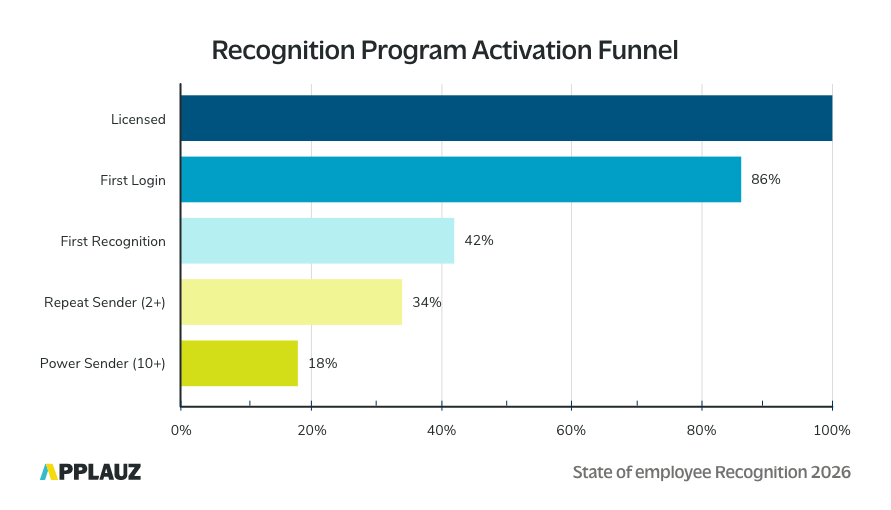
Employee recognition activation is the process of moving a staff member from a passive observer to an active participant in company culture. At Applauz, we’ve identified a significant Activation Gap: a 44-percentage-point drop-off between an employee’s first login (86%) and their first recognition sent (42%). This gap represents the single greatest hurdle to a thriving workplace.
Why Does Recognition Engagement Stall?
These employees aren’t disengaged; they are often simply hesitant to take the first step. The three primary barriers to recognition engagement are:
- Habit Formation: When recognition feels like a "formal task" rather than an everyday conversation, it creates unnecessary pressure.
- Psychological Permission: When recognition expectations are unclear, employees withhold for fear of judgment.
- Social Momentum: When appreciation is rare, employees assume it is not a core requirement of the culture.
While average organizations struggle to maintain a pulse in their recognition feeds, high-performers treat recognition as a social ecosystem driven by two specific groups: managers and "culture carriers." To turn a recognition program into a cultural cornerstone, you must move beyond the mandate and understand the architecture of engagement.

The Activation Window: Turning First Steps into Natural Habits
If you want to create a permanent recognition habit, the 2026 Report suggests that the "launch phase" of any recognition program (or the onboarding phase of a new hire) is the most critical window for intervention. If an employee doesn't send or receive recognition in that first month, the likelihood of them ever participating drops precipitously.
Our research identifies a powerful benchmark: an employee’s behavior in their first 30 days on the platform is a near-perfect predictor of their engagement levels a year later.
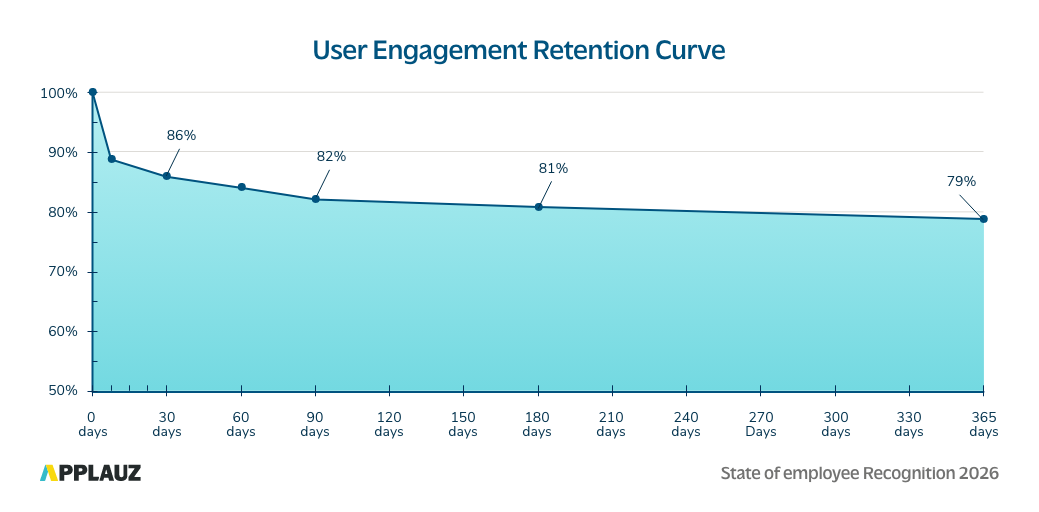
- 30-Day Benchmark: First-send behavior in the first 30 days results in a 92% platform retention rate.
- Long-Term Durability: Once that initial momentum is established, engagement remains remarkably stable, dropping by only 7 percentage points over the entire following year.
- The Psychological Shift: That first send isn't just an action; it's a transition from "observer" to "contributor."
Lowering the Stakes: Casual over Formal
The secret to capturing this 30-day window isn't by demanding high-impact, formal accolades. In fact, that usually backfires by creating "stage fright." To bridge the habit formation gap, we have to reframe recognition as a casual, everyday conversation.
When appreciation feels like a high-stakes performance review, employees wait for "perfect" moments that rarely come. By positioning recognition as a low-pressure social interaction, like a quick "thank you" or a supportive comment, you lower the friction for that critical first send. Once an employee realizes that recognition is a simple, conversational act rather than a formal chore, the habit begins to form naturally, fueled by the positive social feedback they receive in return.
✍️ Applauz turns new users into cultural contributors
Applauz is designed to shorten the distance between "login" and "first send." With an intuitive interface that mirrors familiar social interactions and AI-powered nudges that suggest simple ways to say thanks, we make the first 30 days effortless. By lowering the pressure, Applauz helps your team build the momentum needed for a lifetime of engagement.
The Manager Signal: The Strongest Lever for Engagement
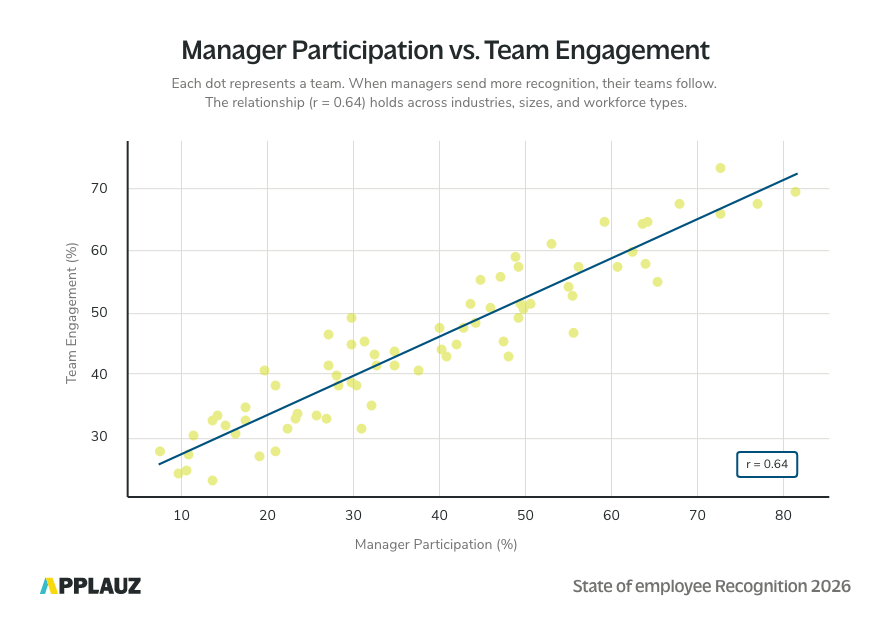
The single greatest predictor of team engagement isn't the size of the reward budget or the variety of the gift card catalog; it is the behavior of the direct supervisor. Our research identified a 0.64 correlation (r = 0.64) between manager activity and overall team participation. The “Manager Signal” is the strongest predictor of team engagement in the 2026 dataset.
The explanation lies in what manager recognition communicates. When managers publicly acknowledge an employee, it sends a clear signal to the team. It sets the standard and reinforces cultural norms, providing the "psychological permission" and “social momentum” for their team to do the same.
This isn't just a soft observation; it’s a measurable performance gap between different organizational tiers:
|
Metric |
High Engagement Orgs |
Average Orgs |
|
Active Manager Participation |
82% |
58% |
|
Silent Managers (0 recognitions sent) |
<10% |
42% |
|
Correlation to Team Engagement |
Strong (r=0.64) |
Weak/Inconsistent |
The "Silent Manager" Problem
The most alarming finding in our report is the prevalence of the "Silent Manager." In average organizations, 42% of managers have never sent a single recognition. These leaders are not just passive; they are active bottlenecks. When nearly half of your leadership team ignores the recognition platform, they send a loud signal that appreciation is a "distraction" from real work.
✍️ Applauz empowers managers to lead by example
The goal for managers is quality over quantity. One genuine recognition per month is enough to send a clear signal to their team. Applauz identifies these low-flow areas and provides managers with training, nudges, and real-time insights to help them become culture multipliers.
The Power User Engine: Your Culture Carriers
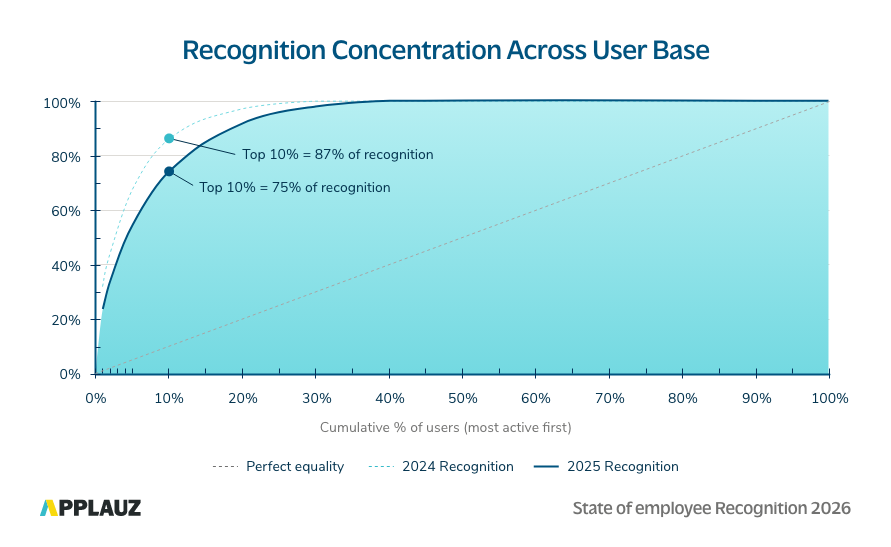
A common mistake HR leaders make is assuming that the most active users must be managers. In reality, the 2026 Report shows that 50% of all recognition comes from peers, and 75% of all recognition comes from the top 10% of your workforce, with the vast majority of these “Power Users” being employees.
Your "Culture Carriers" (AKA "Power Users") are the true engine of your social feed. They don't just participate; they dominate the volume of the platform. These are the people who truly provide the “social momentum” to keep the feed alive, and who model the behavior for everyone else.
|
Metric |
Power Users (Top 10%) |
Average Users |
|
Total Recognition Share |
75% |
25% |
|
Avg Recognitions Sent |
40.6 |
3.5 |
|
Avg Reactions & Comments |
8.5 |
2.6 |
- Power Users recognize 11.6x more frequently than an average user.
- Power Users react to and engage with others’ posts 3.3x more frequently than typical users.
- The 8x Effect: A single Power User generates as much cultural "noise" as 8 average employees.
Not every user needs to be a "Power User" to make a recognition program successful. In fact, trying to force universal high-level engagement often leads to "recognition fatigue" or performative participation. Instead, the goal is to identify and empower the 10% of users who naturally drive the conversation. These individuals act as the social glue, reinforcing others' contributions with reactions, comments, and consistent visibility.
✍️ Applauz turns recognition from a mandate into a movement
Culture isn't forced; it’s sparked. Applauz identifies your natural Power Users who organically drive engagement and visibility. Instead of pushing a top-down mandate that feels like a chore, Applauz provides HR teams with the data to support these grassroots champions, turning individual momentum into a self-sustaining cultural ripple.
Strategy: Closing the Activation Gap
Based on these insights, how should HR leaders adjust their strategy today? It comes down to three specific interventions:
- Optimize the onboarding process: Ensure every new hire is prompted and encouraged to send a recognition within their first two weeks. Use "buddy" systems to ensure they receive one as well.
- Target the "Silent Signals": Don't focus on training everyone. Specifically target the managers who have sent zero recognitions. Moving a manager from "zero" to "one" has a massive ripple effect on their entire team.
-
Empower the Culture Carriers: Identify your top 10% of users. Give them early access to new features, invite them to culture committees, and recognize them for their role in building the community.
Conclusion: From Mandate to Momentum
The path to a thriving recognition culture isn't found in higher-value rewards or more frequent company-wide emails. A thriving recognition culture is a social ecosystem driven by managers and Culture Carriers.
By activating the 82% of managers required for high-performance culture, leveraging the 8x amplification power of your Culture Carriers, and obsessing over the first 30 days of the user journey, you can build a self-sustaining ecosystem. Recognition shouldn't feel like work, it should feel like the heartbeat of the organization.

About the author
 Sandro Mezzacappa
Sandro is the VP of Product & Marketing for Applauz Recognition. He’s been with the company since the very beginning and has the distinction of being Applauz’s very first employee.