

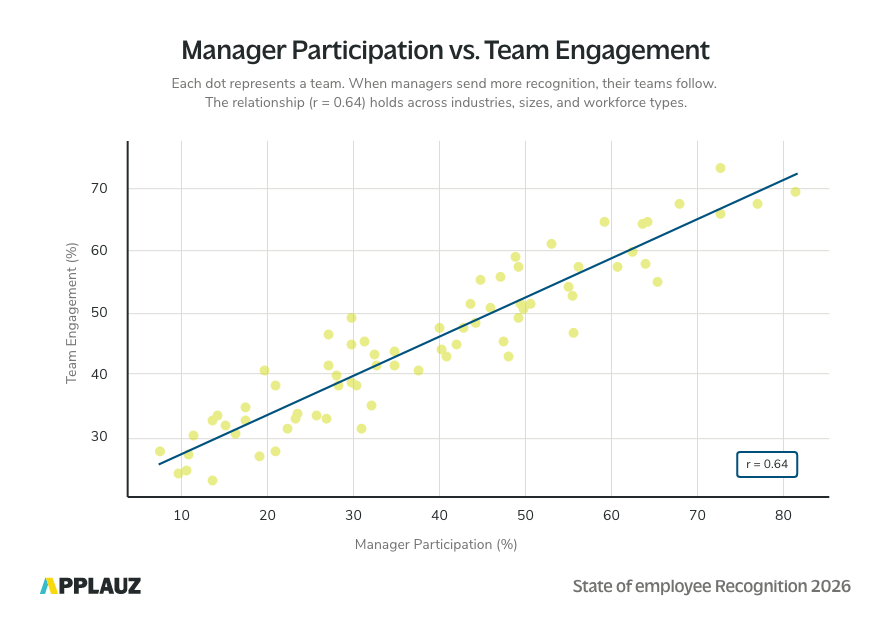
It’s a common misconception that employee recognition programs are driven solely by HR initiatives or company-wide perks. In reality, employee engagement is driven by the Manager Signal, a powerful catalyst where leadership participation triggers a team-wide cycle of appreciation. The State of Employee Recognition 2026 report confirms there is a 0.64 correlation (r = 0.64) between manager participation and team-wide platform engagement, making it the strongest statistical predictor of team engagement.
To build a high-performance culture, leadership must pivot from high-stakes, infrequent reviews to a regular rhythm of appreciation. Success is not defined by recognition volume, but by manager activation—moving leaders from "zero to one" to break the cultural ceiling that often prevents organic team gratitude.

The Power Behind the "Signal Effect"
The impact of manager recognition isn’t measured by frequency alone; it is measured by symbolic authority. Recognition from leadership in a public feed naturally attracts more attention, reactions, and engagement from across the entire organization. It visibly carries a different weight than peer appreciation and reinforces not only individual contribution but also what the organization explicitly values.
- Psychological Permission: Employees take cues from leadership to determine what is truly encouraged. Active manager recognition signals that appreciation is expected rather than just allowed.
-
Real-Time Value Reinforcement: A leader's message does more than thank someone; it translates abstract company values into visible, real-world examples.
The Participation Gap
The difference between a thriving culture and a stagnant one often comes down to a specific threshold of leadership involvement. Data reveals a stark chasm between high-performing and average organizations:
|
Metric |
High Engagement Orgs |
Average Orgs |
|
Active Manager Participation |
82% |
58% |
|
Silent Managers (0 recognitions sent) |
<10% |
42% |
|
Correlation to Team Engagement |
Strong (r=0.64) |
Weak/Inconsistent |
In high-performing organizations, 82% of managers actively send recognition, compared to only 58% in average ones. This creates a "Silent Layer" where 42% of managers never send a single recognition. These managers act as cultural bottlenecks, creating a "cultural ceiling" that prevents the organic growth of appreciation. To break this ceiling, we must dismantle the four specific barriers keeping them on the sidelines:
- Formal Perception: Treating recognition as a high-stakes performance review.
- Favoritism Fear: Staying silent to avoid the appearance of bias.
- Operational Friction: High perceived time and effort required to recognize.
- Misguided Vision: Viewing appreciation as an "HR task" rather than a performance lever.
Barrier 1: The "Formal Trap"
Many managers view a public recognition feed as a permanent, high-stakes record. They treat every post like a mini performance review, worrying about perfect phrasing or waiting for a monumental achievement to justify the effort. This leads to "Blank Page Syndrome," where the perceived mental weight causes the manager to procrastinate until the moment passes.
Reframe Recognition as "Casual" Praise
To dismantle the Formal Trap, we must reframe recognition as a low-stakes, casual shout-out. Shift the focus from perfect prose to "timely truth". Instead of waiting for massive milestones, focus on sharing weekly wins, which habituates the manager to making casual recognitions and lowers psychological stakes for everyone.
✍️ Applauz provides AI recognition assistance
To kill "Blank Page Syndrome," Appy, the AI recognition assistant, helps managers generate warm, values-aligned drafts in seconds. By providing a smart starting line, Appy removes the creative burden and makes it easy to turn a weekly win into a public shout-out.
Barrier 2: Fear of Favoritism
Managers often operate under the belief that recognizing one person will automatically make others feel undervalued. This social anxiety leads them to take the "safest" possible route: recognizing no one at all. While trying to avoid conflict, they are actually starving the entire team of necessary visibility.
Diversify Recognition and Leverage Peers
Managers should look beyond obvious project completers to highlight less visible contributions, such as data clean-up, support roles, or maintaining morale. They can also lean on peer activity by "boosting" or commenting on peer-to-peer recognitions. This validates the peer’s observation while showing the manager is paying attention to team dynamics.
✍️ Applauz surfaces quick awards and smart suggestions
Applauz Quick Awards surface recent peer recognitions to managers, making it easy to "second" a shout-out. Additionally, the platform identifies team members who haven't been recognized in a while, ensuring favoritism is replaced by total team visibility.
Barrier 3: Operational Friction
We must be empathetic to the manager's reality: they are chronically time-poor. If giving recognition takes too much time or requires jumping through hoops to log in to another platform, it will be the first thing dropped when a deadline approaches.
Ecosystem Integration and the Monthly Signal
Recognition should be a seamless extension of the existing workflow, not an interruption. Integrating recognition into daily communication channels lowers the friction of jumping between tasks.
When it comes to frequency, one high-quality recognition per month from a manager is enough to remain an effective catalyst. The Manager Signal carries such an outsized statistical weight. With an r = 0.64 correlation to team engagement, a single action from a leader has a disproportionate ripple effect on recognition program engagement compared to peer activity. You do not need high volume to ignite the engagement engine. You only need to broadcast that the behavior is valued. A consistent monthly pulse ensures the manager remains a catalyst without adding a heavy administrative load.
✍️ Applauz is accessible via Slack, Teams, and Mobile App
Applauz lives where your managers live. With Slack and Microsoft Teams integrations, a manager can send their monthly recognition in under 60 seconds without leaving their chat window. For leaders on the move, the Applauz Mobile App ensures the Manager Signal can be broadcast from anywhere.
Barrier 4: Missguided Vision
Many managers stay silent because they view recognition as an "HR Task" or administrative overhead. They haven't yet connected the dots between a public shout-out and the tangible impact on their team’s quarterly output. Without a clear vision of why they are recognizing, it feels like a chore rather than a strategy.
Viewing Recognition as a Performance Lever
Leadership must rebrand recognition as a tool for motivation and alignment. By using Company Value Badges, managers can move beyond a generic "good job" to specifically highlight behaviors that drive the business forward. Tagging a recognition with a badge like "Customer First" reinforces a performance standard for the entire team to see, which turns every shout-out into a mini-lesson in company strategy.
However, the true shift in mindset occurs when managers can see the quantitative impact of these actions. Showing leaders the direct link between their participation and team sentiment transforms recognition from a soft skill into a data-backed leadership strategy. When a manager can see their team's engagement scores climb following a consistent month of activity, the task is no longer viewed as a mandate. Instead, it becomes a proven method for maintaining a high-performance culture. Seeing the data provides the "why" that turns a silent manager into a vocal advocate.
✍️ Applauz offers custom badges and real-time insights
Applauz makes this strategic alignment effortless with Customizable Value Badges anchored in desired performance traits. These actions are then funneled into Real-Time Engagement Reports. These insights provide managers with a clear view of which values are thriving and provide the data they need to see exactly how their recognition is moving the needle on team morale.
Takeaways for HR Teams
A thriving recognition culture is not a top-down mandate; it is a social ecosystem that requires a catalyst to flourish. To move your "Silent Layer" into action, keep these key takeaways in mind:
- For "Silent" Managers: Focus on moving them from zero to one. Do not push for volume. Encourage short, timely, and casual recognitions to break the initial barrier.
- For "Active" Managers: Shift the focus from quantity to strategic quality. Challenge them to use Value Badges to reinforce specific performance goals and recognize unsung contributors.
- Reframe the Time Commitment: Promote a "once-per-month" standard. Making it a quick, high-impact action rather than a daily chore significantly reduces operational friction.
- Bridge the Data Gap: Use engagement insights and reporting to show managers that their Signal is a primary driver of team retention and performance.
When you move a manager from zero to one, you aren't just adding a post to a feed. You are lifting a cultural ceiling, clarifying your company's vision, and finally giving your people the permission they need to excel.

About the author
 Sandro Mezzacappa
Sandro is the VP of Product & Marketing for Applauz Recognition. He’s been with the company since the very beginning and has the distinction of being Applauz’s very first employee.