


When running an employee recognition program, HR teams often focus on participation rates: How many people are logging in? How many points are being sent? While user activation is step 1, recognition volume alone is a vanity metric. If your platform is filled with short messages like "Great job!" or "Thanks for the help! 🚀", you are feeding your culture empty calories.
According to the State of Employee Recognition 2026 report, high-impact recognition is the transition from generic praise to specific, value-aligned storytelling.
The data is clear: Specificity and alignment are the 3.4x multipliers.

The Data: Why Length is the Leading Indicator of Engagement
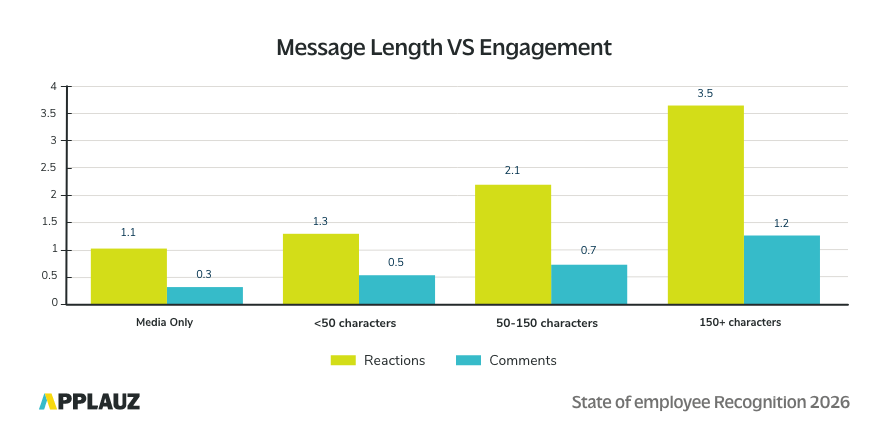
Our research analyzed all recognition moments between 2024 and 2025 to find the "tipping point" for engagement. We found that as the character count increases and provides space for context and value alignment, the Signaling Effect skyrockets.
Long messages get 3.4x more comments & reactions than media-only posts. A GIF gets seen. A thoughtful, personalized message gets felt.
|
Message Length |
Avg. Reactions & Comments |
Impact |
Why This Matters |
|
Media Only |
1.4 |
Low |
A "check-the-box" task. |
|
Short (<50 chars) |
1.8 |
Low |
Provides no context. |
|
Medium (50-150 chars) |
2.8 |
Medium |
Provides limited context. |
|
Long (150+ chars) |
4.7 |
High |
Tells a story that others can learn from. |
Why the 3.4x jump? When a peer or manager writes a 150+ character story, they aren't just saying "thank you." They are providing a blueprint. For a remote employee sitting in a home office, that message is their primary window into the company's "unwritten rules" for success.
The Psychology: Why the Brain Craves Specificity
Generic praise like "Good work" triggers a brief hit of dopamine, but it fades almost instantly because the brain doesn't know how to replicate the success. Specific recognition, however, triggers Oxytocin, widely known as the 'bonding molecule.”
When an employee hears exactly how they contributed, the brain perceives it as a Status and Certainty win:
- Status: "I am uniquely valuable for my specific technical or soft skill."
- Certainty: "I now know exactly what I need to do to be successful again tomorrow."
Without specificity, employees often feel "imposter syndrome" or anxiety about whether their "good work" was just a fluke. Specificity is the foundation of psychological safety required for high-level innovation.
The New Recognition ROI Formula
To move from "empty calories" to high-impact feedback, we must give recognition a framework that reinforces the brand. We call this the Recognition ROI Formula:
Specific Action + Value Alignment + Business Result = Cultural Impact
- Specific Action: What exactly did they do?
- Value Alignment: Which company value does this demonstrate?
- Business Result: What was the actual outcome for the team or client?
The Anatomy of a High-Impact Post
Let's look at two common workplace scenarios and how to "upgrade" them to reach that 3.4x engagement level:
|
Scenario |
Instead of |
Using ROI Formula |
|
The "Customer First" Win (Operations) |
"Thanks for helping that angry client today!" |
"Sarah, Thanks for helping that angry client today! When they called frustrated about their shipping delay, you spent 30 mins listening to them “rant” without losing your cool, you responded professionally and then took the time to personally track down the package for them [Action]. This is a perfect example of our 'Customer First' value [Value Alignment]. Your extra effort today turned a potential churn into a five-star review and a subscription renewal [Result]. Fantastic work!" |
|
The "Innovation" Pivot (Product/Engineering) |
"Great job on the new feature!" |
"Great job on the new feature launch, Marcus! Your timely proposal of using the new API architecture for the Q3 launch was genius [Action]. This perfectly aligns with our value of 'Bold Innovation' [Value Alignment]. This change didn't just fix the bug; it reduced our server latency by 20%, saving the team hours of troubleshooting [Result]." |
The "Manager Signal": Turning on the Power
While a well-crafted recognition has a strong Signaling Effect. That same message coming from a manager rather than a peer carries a unique weight. We call this the Manager Signal.
The 2026 report confirms there is a 0.64 correlation (r = 0.64) between manager participation and team engagement. On the flip side, the data also shows that 48% of managers have never sent a single recognition. When a manager's signal is "off," their team often feels invisible, regardless of how much peer praise they receive.
- Step 1: Turn on the Signal. The first goal for HR is simply building the habit by getting managers to recognize at all. (For more on building this habit, see our guide on The Manager Signal).
- Step 2: Improve the Signal. Once the habit is formed, we move to quality. A long, detailed message from a manager strengthens that signal and ensures lasting cultural effect.
Recognition Language: A Mirror of Your Workplace Culture
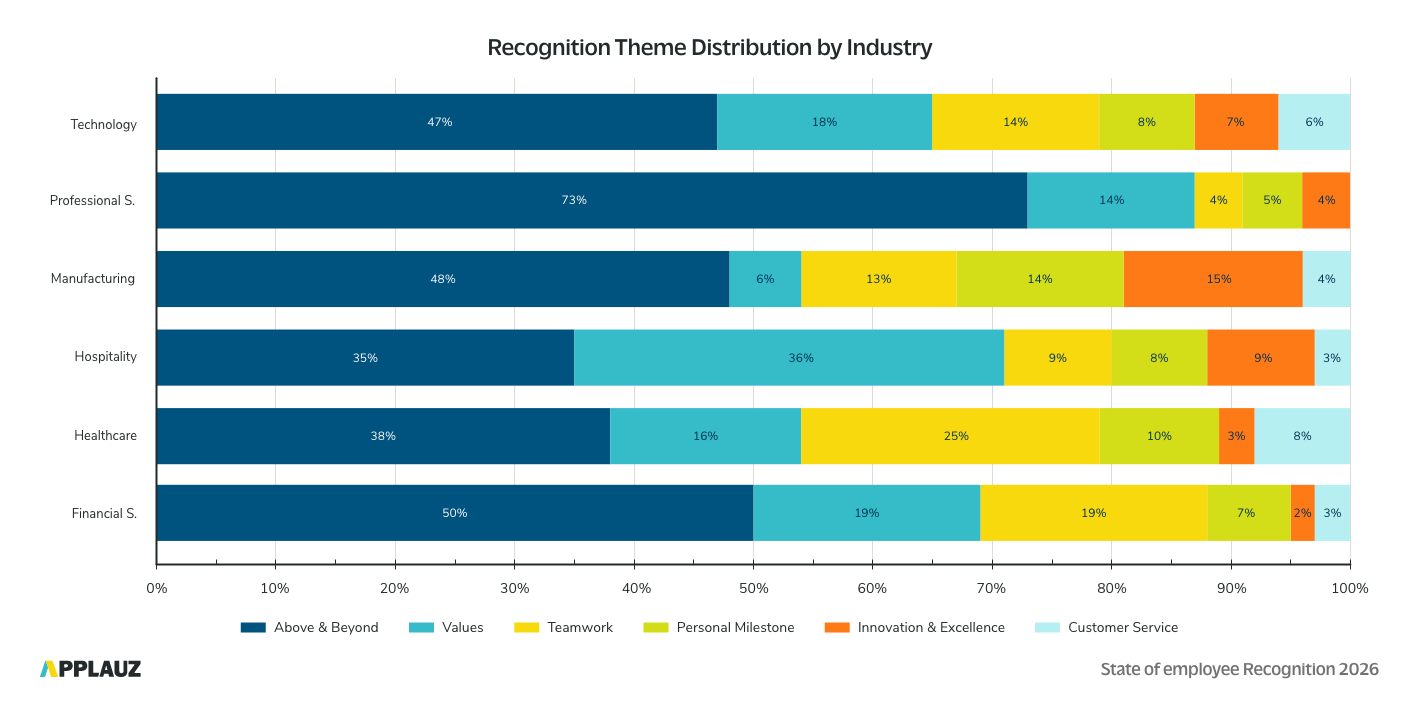
Recognition language reflects what organizations deem important, and the 2026 report highlights that different industries emphasize different things. These variations act as a "cultural mirror."
|
Theme |
Technology |
Professional Services |
Manufacturing |
Hospitality |
Healthcare |
Financial Services |
|
Above & Beyond |
47% |
73% |
48% |
35% |
38% |
50% |
|
Values |
18% |
14% |
6% |
36% |
16% |
19% |
|
Teamwork |
14% |
4% |
13% |
9% |
25% |
19% |
|
Personal Milestone |
8% |
5% |
14% |
8% |
10% |
7% |
|
Innovation & Excellence |
7% |
4% |
15% |
9% |
3% |
2% |
|
Customer Service |
6% |
0% |
4% |
3% |
8% |
3% |
- Professional Services is nearly monolithic. 73% of categorized recognitions celebrate going above and beyond. In project-based, client-facing work, discretionary effort is the currency that matters most.
- Healthcare reflects a culture of interdependence. Teamwork leads with a 25% share, the highest of any industry, as patient care is inherently collaborative. Customer Service also doubles the average at 8%, where in this environment, service is a direct proxy for compassion.
- Hospitality is the only industry where Values edges out Above & Beyond (36% vs. 35%). Service culture runs deep. Day-to-day recognition reinforces brand values and guest experience rather than exceptional individual effort.
- Manufacturing shows the highest Innovation & Excellence share at 15%, nearly double the cross-industry norm. Process improvements, safety innovations, operational breakthroughs; these get noticed and named.
Perform a Value Alignment Audit
This recognition theme data is the most accurate "thermometer" for your company culture. By analyzing which Value Badges are being used most frequently, HR can perform a Value Audit.
If your corporate values emphasize "Innovation," but your recognition feed is 90% "Hard Work" and "Reliability," you have a Value Gap. It says your employees are being rewarded for "grinding," not for "thinking differently."
Use this data to realign leadership. If "Innovation" is the goal, leaders must start intentionally recognizing and "tagging" innovative behaviors to shift the cultural distribution.
The HR Leader’s Playbook for 2026
To transform your program from a "social feed" into a "culture engine," follow these three strategic steps:
- Track the "Habit" AND the "Quality": Continue tracking Active Users to ensure the habit is sticking. But add a second KPI: Average Message Length. Use this to identify "Quiet Zones" in the organization where the Manager Signal might be weak.
- Incentivize Quality for Active Users: For those who are already active recognizers, run "Recognition of the Month" spotlights. Choose winners based on how well they used the ROI Formula (Action + Value + Result) rather than just who sent the most points.
- Perform a Value Alignment Audit: Every quarter, pull a report on your Value Badge distribution. Does the data match the culture you want to build, or the one that currently exists? Use this to validate your cultural alignment with the executive team.
Conclusion: Specificity is a Superpower
Embrace the 3.4x power of value-aligned specificity as it can pivot the direction of your company’s culture. Effective recognition isn’t about eloquence, it’s about attention and intention. The most powerful messages come from peers, and more importantly leaders, who observe closely and share the story behind the achievement.

About the author
 Sandro Mezzacappa
Sandro is the VP of Product & Marketing for Applauz Recognition. He’s been with the company since the very beginning and has the distinction of being Applauz’s very first employee.