


The cost of frontline employee turnover is one of the largest unmanaged expenses in hybrid organizations, and most employee engagement strategies weren't built to address it. For companies with both office-based and deskless workers, the gap between HR program design and frontline reality quietly drives attrition that is both predictable and expensive.
The employee your HR software was almost certainly designed around is the one who starts their day at a desk, opening a computer, and logging into some kind of messaging app or intranet.
For a lot of organizations, that employee represents only half the story.
The other half? Driving a delivery truck before sunrise. On the production floor before the office coffee is brewed. Checking in patients, pouring concrete, stocking shelves, processing shipments, or operating heavy equipment somewhere a laptop would be a liability.
These are your frontline workers. Your deskless employees. And in 2026, they're leaving at a rate that should make any HR leader at a hybrid organization uncomfortable.
Your organization has two workforces. Most HR programs serve one.

If your organization has both office-based and frontline employees, you're part of a large and consistently underserved segment of the workforce. Construction, healthcare, transportation and logistics, manufacturing, food production, automotive, and hospitality all routinely operate with mixed workforces, which puts some people at desks, and others doing physical work in the field, on the floor, or on the road.
This split creates a management problem that's easy to miss because it's structural, not personal.
Most HR systems, recognition platforms, and engagement programs were built with desk workers in mind. They assume employees have consistent access to email or a company app on a computer. They assume employees have a quiet five minutes to click through an HR survey or log into an employee recognition portal at some point during the day.
Frontline workers often don't have that. Their environment doesn't allow for it.
So when the tools meant to connect, recognize, and retain employees don't actually reach a significant chunk of your workforce, those employees feel it. They disengage. They start looking. Eventually, they leave, and you're left with an exit interview that says something like "I didn't feel valued" and a recruiter invoice you didn't budget for.

What does frontline turnover actually cost?

The cost of frontline employee turnover is the total expense of replacing a deskless or hourly worker; recruiting fees, screening time, onboarding, training, and the productivity gap while someone new gets up to speed. SHRM puts this figure at 50% to 200% of the departing employee's annual salary, with specialized frontline roles trending toward the higher end.
Annual turnover in frontline construction and transportation roles regularly approaches 47%, according to BLS Job Openings and Labor Turnover Survey data — making workforce retention one of the sector's most persistent operational challenges.
Do the math on a construction or transportation company with 400 employees, 60% of them in frontline roles. A 25% annual turnover rate (conservative for the sector) means replacing 60 people a year. At $15,000–$20,000 per replacement, that's $900,000 to $1.2 million walking out the door annually. Before you count the impact on project timelines, safety records, or customer service.
The financial hit is real. But the cultural hit is also worth stating.
Every time a frontline employee quits, their teammates notice. They absorb extra shifts. They cover gaps. And they watch a colleague leave while asking themselves the question that person was probably asking before they handed in their notice: Does this company actually care about me?
Turnover becomes contagious. In frontline roles, where team cohesion directly affects safety, quality, and operational output, one departure can set off a chain reaction that takes months to stabilize.

Why do frontline workers disengage faster than desk employees?

Disengagement rarely happens overnight. It's a slow erosion, and in frontline roles, three specific things tend to accelerate it.
The first is visibility, or the absence of it. Frontline workers often operate out of sight, for example, on job sites, in distribution centers, in patient rooms, on delivery routes, and on factory floors. When leadership doesn't see them regularly, recognition becomes invisible by default. The office team gets praised in the all-hands meetings, and the floor team gets a safety bulletin.
The second is disconnection. Frontline employees are significantly less likely to receive timely company communications, participate in team culture moments, or feel part of what's happening across the broader organization. In hybrid workforces, there's often an unspoken divide between desk and deskless employees; it’s one nobody designed, but most people feel.
The third, and the one that drives the most attrition, is the absence of recognition. Gallup finds that employees who don't receive adequate recognition are 2x more likely to report plans to leave within the next 12 months. For frontline workers, people who already deal with demanding conditions, irregular schedules, and limited career visibility, being overlooked doesn't just sting; it bites. It confirms something they may already be suspecting, that they're interchangeable. The company sees them as labor, not people.
Once that story takes hold, a pizza party and an annual review aren't going to change it.
The recognition gap hiding in your engagement data

Most employee recognition programs are built for people who are already connected.
Peer-to-peer recognition only works when both people have regular access to the platform. Anniversary emails only land when the employee has a company inbox they actually check. Manager shoutouts in team meetings only reach the people in the room at that moment.
Frontline workers often don't have a corporate email address. They may be mid-shift when a recognition moment happens, or somewhere pulling out a phone isn't an option. Programs built around desktop logins and email notifications create a structural gap, and without meaning to, a two-tier culture. Not because anyone intended to exclude frontline employees. But because the implementation, and even the very design of the company recognition program, assumed everyone works the same way.
That gap shows up in your data. It's why engagement scores for frontline roles often look different from the rest of the organization. It's why exit interviews from deskless workers keep producing the same phrases: "I didn't feel like I was part of the team." "I didn't feel like my work was noticed."
Organizations that are holding on to frontline workers in 2026 have stopped treating recognition as a desk-worker benefit. They've started treating it like an operational requirement and something that needs to reach every employee, on whatever device and in whatever environment they actually work in.
What does effective frontline recognition actually look like?
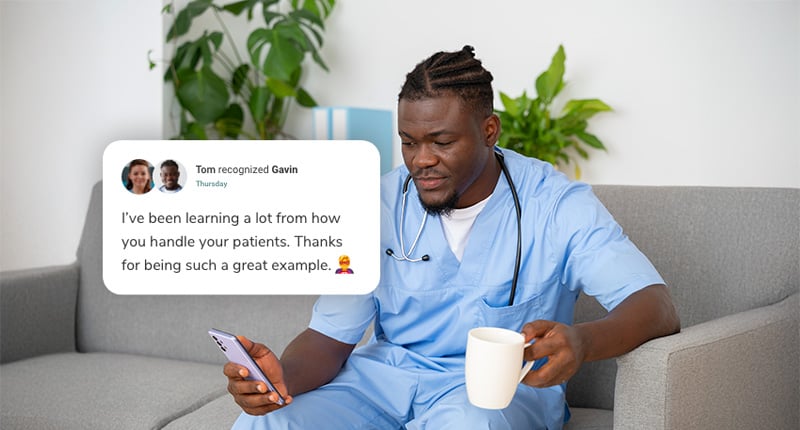
Four practices define how organizations hold onto their frontline workers: replacing email with SMS-based communication, building recognition into manager-led daily standups, using digital signage to keep deskless teams informed, and segmenting engagement data by role type rather than averaging it across the org.
Recognition has to work on a phone with spotty connectivity, because that's often the only option. A mobile-first tool, an SMS-based award notification, and a manager who can hand out a recognition directly on the floor, these aren't nice-to-haves. If your recognition platform requires a desktop login or a corporate email to function, it wasn't designed for your frontline workforce, full stop.
Recognition also has to become part of how managers already lead, not an extra thing HR is chasing people to do. The teams that make this stick, integrate it into the rhythms managers own anyway with shift briefings, safety check-ins, and end-of-week huddles. Recognition becomes a habit rather than a project.
Communication matters too, and it's often more fixable than people think. Frontline workers who feel informed feel more connected. Digital signage, team newsfeed tools, manager-mediated updates, these aren't glamorous, but they're the difference between a deskless employee who knows what's going on in the company and one who feels like an afterthought.
And then there's measurement. If your overall engagement score looks healthy but frontline turnover is high, you're averaging away a real problem. Segmenting engagement data by role type, location, and department is how you catch these patterns before they become a retention crisis.
Conclusion: The Window Is Narrowing
.jpg?width=800&height=571&name=chef-cooking-kitchen-while-wearing-professional-attire%20(1).jpg)
The labor market for frontline workers is not getting easier.
Demographic shifts, the rise of gig work alternatives, and changed expectations post-pandemic have permanently raised the bar for what frontline employees expect from employers. They want to feel respected. They want schedule flexibility. They want to work somewhere that actually notices when they do their job well. And increasingly, they have options.
If your employee engagement strategy was designed for your desk workforce and applied uniformly to everyone else, that approach will show its limits in your turnover numbers, that is, if it hasn't already.
The gap is closeable. Plenty of hybrid organizations are closing it, not by replacing their HR stack, but by extending recognition and communication to the employees who weren't included when the original programs were built.
Retention in a hybrid workforce doesn't get decided in the boardroom. It gets decided on the floor, on the job site, in the facility, and in the small moments where someone either feels seen or doesn't.

Want practical retention insights in your inbox?
Subscribe to the Applauz newsletter.
About the author
 Sandro Mezzacappa
Sandro is the VP of Product & Marketing for Applauz Recognition. He’s been with the company since the very beginning and has the distinction of being Applauz’s very first employee.